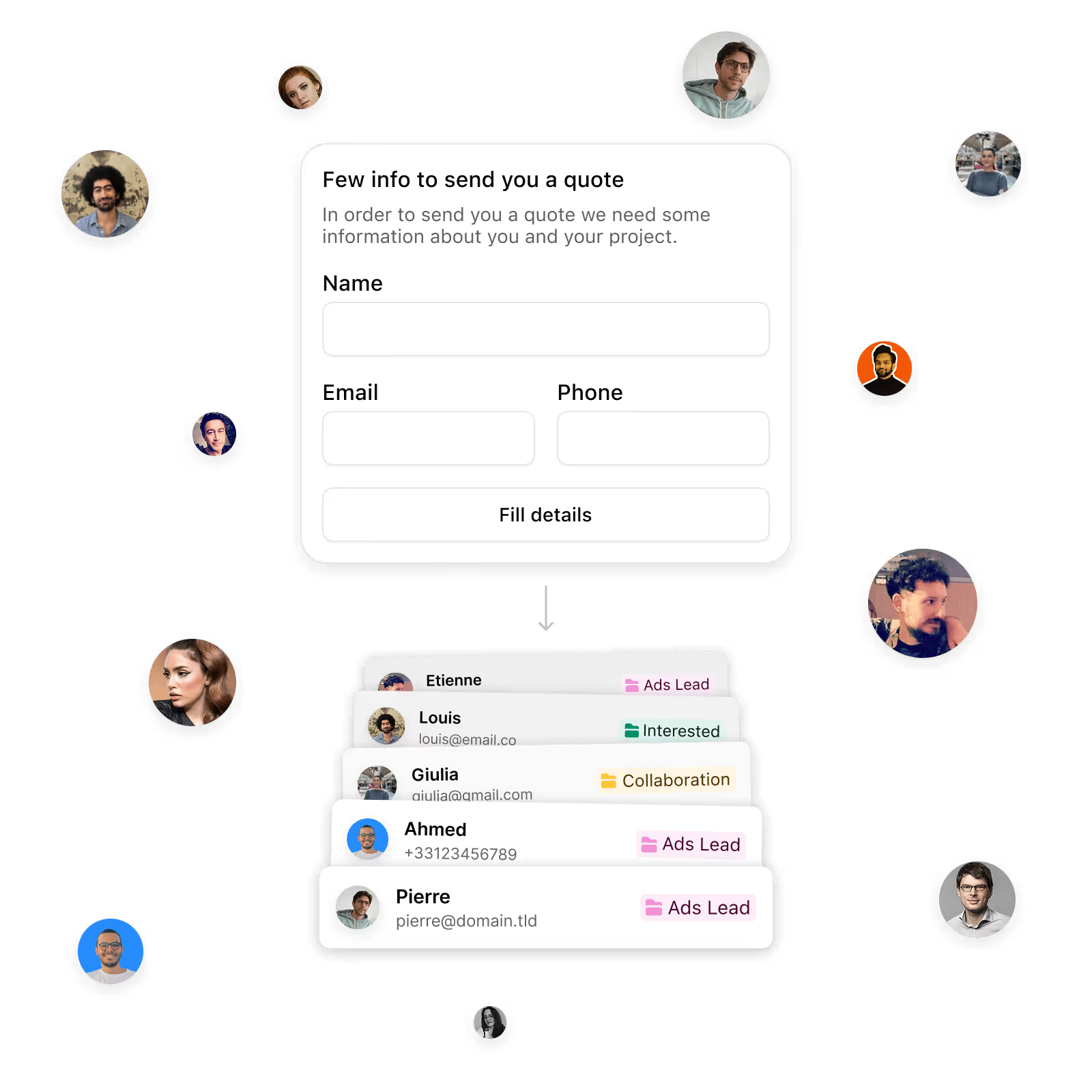
See what manual DMs cost you
How much time do Instagram DMs actually take?
Instagram DM automation is software that answers your comments and direct messages for you, and its time saving equals your message volume multiplied by the seconds each reply takes you, minus what the tool costs. No published study measures that per-reply figure for Instagram. Measure your own: time ten real replies and divide by ten.
What automation is worth depends on two things you know: how many messages you handle, and what an hour of your attention is worth. Anaïs Garnier, CEO and co-founder of the app WeInk, says Inrō saves her at least two hours every day. That is one testimonial, not a benchmark, which is why this calculator starts from your numbers instead.
How this calculator works
- Count your volume. Enter the DMs and comments you handle, per day or per week.
- Measure one reply. Time ten real replies, divide by ten, and put that number in the assumptions panel.
- Read the net line. You get hours back, what they're worth, and what's left after the subscription.
Why price the hours before you automate
- It can say no. Below about 11 messages a week at the defaults, the subscription costs more than the time it returns.
- Hours only. The sibling DM ROI Calculator prices what automation earns. This one prices what manual handling costs you.
- The number is yours. Seconds per reply is the input nobody can source, so you get a stopwatch method instead of an average.
- Defensible in a meeting. Every default is labelled and editable, so a client can dispute an assumption and watch the net figure move.
What published research actually measures about message time
Every figure this calculator could have leaned on, and what each one measured:
Not one of these times a reply to an Instagram DM. The nearest figure is arithmetic on that study's own table: 1 hour 23 minutes across 77 checks is roughly 64 seconds per inbox visit, and a visit is not a reply. That gap is why this calculator asks you to time ten replies.
Handling DMs by hand vs automating with Inrō
Manual DM management
Just answering as fast as you can
Warmest leads go cold before you reply
Miss everything while you're offline
No lead capture or CRM tagging
Engagement rarely turns into sales
Inrō automation
Instant replies + lead capture
Auto-reply to every comment in seconds
Works 24/7, never miss a follower
Every lead tagged in Smart Inbox & CRM
Turns engagement into booked revenue
Start free with Inrō
Four ways to get a number you can defend
- Time ten replies, not one. A single reply is noise, but ten in a row average out the quick answers and the long ones.
- Count comments as well as DMs. Comment replies usually run shorter than DMs, so a mixed inbox pulls your average seconds per reply down.
- Price your hour honestly. The EU average hourly labour cost was €34.90 in 2025 and ran from €12.00 to €56.80 by country (Eurostat, 31 March 2026).
- Re-run it after a launch. Volume spikes are when manual replying breaks, so measure your busiest week rather than your quietest one.
What throws this estimate off
Guessing the seconds
Guessing at your seconds per reply is the fastest way to double or halve every number below it.
Counting hours as profit
Hours only turn into money if you fill them with paid work, so the money line is a ceiling.
Ignoring the setup hours
Building and testing a flow takes real time in month one, and this calculator does not charge you for it.
Automation is cheap and your hours are not, so the question is never whether the subscription is worth it. It is whether the hours are real. Measure ten replies before you decide, because that single number moves this estimate more than anything else on the page.
Get those hours back
Set a keyword trigger and Inrō answers comments and DMs in seconds. The free plan covers 100 active contacts a month, 3 automations, 3 campaigns and 50 AI credits, no card.
Start for free
Trusted by 10,000+ creators and brands
, including Walmart & Yoyomatch
Frequently asked questions
How much time do Instagram DMs actually take?
No published study answers this for Instagram, and any calculator quoting one is quoting itself. The closest instrumented research measures email. Mark, Iqbal, Czerwinski, Johns and Sano logged 40 information workers for 12 workdays and reported 1 hour 23 minutes a day in the email client across 77 checks (CHI 2016), using software that counted seconds with the client in the foreground window. Divide those two published means and you get roughly 64 seconds per visit to the inbox. A visit is not a reply, and email is not Instagram, so read it as an order of magnitude. The honest method takes two minutes: time ten real replies and divide by ten.
Where does the two hours a day figure come from?
It is one customer's testimonial, not a study, and it is worth showing you exactly what it is. Anaïs Garnier, CEO and Co-founder of WeInk, says: "I used to do this manually. Inrō saves me at least 2 hours everyday." Inrō publishes that line across roughly ten pages, and it also sits on the WeInk case study. What it establishes is that one founder, running one kind of DM campaign, reports saving on that scale. What it cannot establish is your saving, because her volume, her message mix and the process she replaced are not published. A second Inrō customer, a Miami plastic-surgery clinic, logged 0 hours of front-desk time on an inbox that handled about 1,000 DMs in two weeks. Also one case. Neither number prefills anything here.
Is DM automation cheaper than hiring an assistant?
On price alone, almost always, and that is why price is the wrong question. Inrō Pro is €12.99 a month (pricing page, read 2 August 2026). At the EU average hourly labour cost of €34.90 for 2025 (Eurostat, 31 March 2026), that subscription costs about 22 minutes of one person's time a month. The real comparison is what each one is good at. An assistant handles what a script cannot: complaints, negotiations, refunds, anything needing judgement or an apology. Automation handles the same question asked for the fortieth time, in seconds, at three in the morning. Most inboxes need both, which is why this calculator asks what share you would automate instead of assuming all of it.
What share of Instagram DMs can actually be automated?
Nobody has measured it for Instagram, so here is every number that gets quoted and what each one really is. Inrō publishes "up to 90% of repetitive comments and DMs" for its own AI on its agencies page, which is a vendor claim about its own product. Gartner predicts that agentic AI will resolve 80% of common customer service issues without human intervention by 2029 (press release, 5 March 2025), which is a forecast about a different channel and is routinely requoted as though it described today. A loose family of "80% of routine queries" figures circulates in chatbot marketing with no traceable study behind it. The calculator defaults to 60% and asks you to check that against your own last twenty replies.
Why does this calculator subtract the subscription?
Because a saving that ignores its own cost is a sales pitch. Most automation calculators show you gross hours and the money those hours represent, then park the tool price in a footnote. This one puts the net number on the result card: your saved hours, valued at the rate you entered, minus what the tool charges each month. The cost field is editable, so you can price a competitor, an annual plan or an assistant's retainer in the same place. The consequence is that the calculator can return a negative number and turn its card red. At low volume it does exactly that, then prints how many messages a week you would need first.
How many messages a week before automation pays for itself?
At this page's defaults, about 11 a week. The arithmetic is the same one the calculator runs backwards: a €12.99 subscription divided by €34.90 an hour is roughly 22 minutes of saved time a month, and 11 messages a week at 45 seconds each, with 60% of them automated, produces about that much. Change any input and the threshold moves, so the tool recomputes it and prints it whenever your result comes out negative. Two cautions before you use it as a rule. It ignores setup time, which is real in the first month and is not charged anywhere in this model. And it prices only time, so a small account may still automate for response speed or overnight coverage rather than for hours.
Do the saved hours actually turn into money?
Only if you fill them, and the page is deliberate about saying so. The money line here is a valuation rather than a payout: it states what those hours would be worth at the rate you entered, which is the right way to compare automation against other things you could do with the same time. It becomes cash in two situations. If somebody is paid to answer the inbox, the saving lands on your payroll line. If you bill by the hour and you are turning work away, the freed hours convert at your billing rate. In every other case, read the hours figure as the honest output and the money figure as a ceiling.
Why is the default hourly value 34.90 euros?
Because it is dated, defined and published, which the round numbers other calculators prefill are not. It is the average hourly labour cost across the whole economy in the EU in 2025, released by Eurostat on 31 March 2026. Hourly labour cost means wages plus non-wage costs per hour worked, and the whole economy here covers every activity except agriculture, public administration, private households as employers and extraterritorial bodies. It is also almost certainly wrong for you. Member state averages ran from €12.00 in Bulgaria to €56.80 in Luxembourg, and a coach billing €150 an hour sits nowhere on that scale. Overwrite it with your own rate before you read any of the money figures.
How is this different from the DM ROI Calculator?
They answer two halves of one decision and share no numbers. This page prices the time side: how many hours manual replying takes you, what those hours are worth at your rate, and what is left once the subscription is paid. The DM ROI Calculator prices the revenue side: the conversions that a faster and more consistent reply recovers, and what they are worth to you. Reach for this one when the objection is that you have no time, and for that one when the objection is that you want to see a return. Do not add the two results together. Saved hours and recovered revenue can describe the very same automation twice, and adding them double counts it.
Kshitij runs the growth experiments and looks after client success from first trial to enterprise rollout at Inrō. The advice in these tools comes from funnels he has tested on real accounts, and from the support tickets that follow when a setup goes wrong.