Build your qualifying questions
How this generator works
- Pick what you sell. Five offer types change the wording of every question, from coaching to a bookable appointment.
- Set the price band. It decides how directly the money question can be asked, and nothing else.
- Tick what disqualifies. Each box adds one question, placed in the order a stranger will answer.
How the question set is built
Why a labeled set beats a list of questions
- Every question is labeled. Each one shows whether it screens fit, timeframe, budget or authority. Drop the ones you never reject anyone over.
- Written for one message. Each question fits a single DM, so nobody opens their inbox to a pasted form.
- The order is argued, not assumed. Fit before timeframe before budget before authority, with the reason printed under the set.
- It works at list scale. One campaign by the UK property educator Harvey Growth reached 7,419 contacts and flagged 1,537 of them as interested.
What ten ranking pages actually give you
We checked the ten most popular qualifying-question guides in August 2026. The count is each page's own number where it states one, and a count of its question list items where it doesn't.
The ten pages offer 229 questions between them, and not one is formatted for a one-question-per-message thread; the channels named are booking forms, website forms, intro calls and discovery calls. One page dates BANT to IBM in the 1950s and cites nothing, and no page links IBM's own BANT form. The four pages that spell the acronym out read the T as Timeline or Timing; IBM's own form says Timeframe.
Handling DMs by hand vs automating with Inrō
Manual DM management
Just answering as fast as you can
Warmest leads go cold before you reply
Miss everything while you're offline
No lead capture or CRM tagging
Engagement rarely turns into sales
Inrō automation
Instant replies + lead capture
Auto-reply to every comment in seconds
Works 24/7, never miss a follower
Every lead tagged in Smart Inbox & CRM
Turns engagement into booked revenue
Start free with Inrō
The ground rules for qualifying in a DM
- Send one question per message. A DM thread shows one bubble at a time, so a stacked list gets one answer and three ignored.
- Cut the screens you never enforce. If you have never turned anyone down over timing, that question is costing you a message and buying nothing.
- Ask money after fit. Ardath Albee argued in July 2013 that budget screens misfire because complex purchases often start unbudgeted.
- The labels are a record. IBM's BANT form is completed after a sales call, so the letters file what you learned, not what you ask.
Three ways a question set backfires
Opening with budget
Asking price before fit reads as a filter on them rather than on the offer, and it's the fastest way to lose the thread.
Pasting the whole set at once
Four questions in one bubble is a form, and a form in a DM gets answered once or not at all.
Screening on nothing you enforce
A question you never act on still costs a message and still invites an answer you will have to ignore politely.
BANT tells you what to know about a lead, never what to ask first. IBM's own form is completed after a sales call. In a DM you get one question per message, so order them by what a stranger will answer.
Ask these automatically in DMs
Paste these questions into Inrō's AI agent and it asks them one at a time, files each answer and routes the lead. The free plan covers 50 AI Agent credits and 100 active contacts a month.
Start for free
Trusted by 10,000+ creators and brands
, including Walmart & Yoyomatch
Frequently asked questions
How do I qualify a lead in Instagram DMs?
Ask one question per message, and only about things you would really turn someone down over. Start with context, because it is the only question a stranger answers out of interest rather than obligation. Then screen fit, so you learn what they have tried and where it stalled. Timeframe comes next, since it costs them nothing to answer and it separates now from someday. Budget sits third, because asking about money before fit reads as a filter on the person instead of on the offer. Authority goes last, since it only matters once the first three have said yes, and it is the most awkward thing to ask someone who followed you yesterday.
How many qualifying questions is too many?
In a DM, more than five. This generator caps the set at five for that reason: a context question plus one question per screen you tick, and there are only four screens. The practical floor is three, because a single screen is a conversation rather than a qualification. The real limit is not a number, though, it is whether you would act on the answer. If you have never declined anyone over timing, the timing question buys you nothing and costs you a message. Untick it. A three-question set you enforce sorts leads better than a nine-question set you ignore.
Where does BANT actually come from?
Almost every article says IBM invented BANT in the 1950s and cites nothing. We went looking for the original source and couldn't find one: no IBM publication, patent, training manual or archive page we could locate dates the acronym, and none of the ten ranking pages we checked in August 2026 links one either. What IBM does publish is the form. Its BANT Criteria Template v3.4, November 2008, sits on IBM's own public server and states that opportunity records lacking descriptions of a customer's Budget, Authority, Need and Timeframe will be rejected as incomplete. So the framework is documented. Its origin story is not, and we say so rather than repeat it.
Does this generator use AI?
No. Every question in every set was written by hand and stored in the page. Your two dropdowns and four checkboxes pick which of them appear and in what order, so the same inputs always return the same questions, and you can check that yourself by switching away and switching back. Nothing is sent anywhere, nothing is stored, and there is no waiting spinner because there is nothing to wait for. The upside of that trade is auditability: you can read the reason for every question on this page. Inrō's AI agent, which is a separate product, is the thing that asks these questions live and reads the answers.
Should I ask about budget in a DM?
Only after fit, and only if price is something you actually decline people over. Below roughly 100 in your currency the budget question rejects almost nobody, so this tool flags that and suggests spending the message on fit instead. Above that, the wording should match the number: a mid-band offer earns "what range were you expecting this to sit in?", while a high-ticket offer can ask whether the budget is already signed off. The criticism is old and named. Ardath Albee argued in July 2013 that budget screens misfire on modern buyers because complex purchases often begin without a line item at all.
How is this different from a discovery call script?
A discovery call gives you thirty minutes, tone of voice and the ability to follow up on an answer in real time, so its questions can be long, layered and open. A DM gives you one bubble at a time from someone who is probably scrolling. That changes the writing, not the criteria: the screens stay the same four, but each question has to survive on its own, fit in one message, and still be answerable in a sentence. Every question here is under ninety characters and contains exactly one sentence. That is the whole difference, and it is why the ten pages we checked, all of them written for calls and forms, do not transfer.
Can qualifying questions be asked automatically?
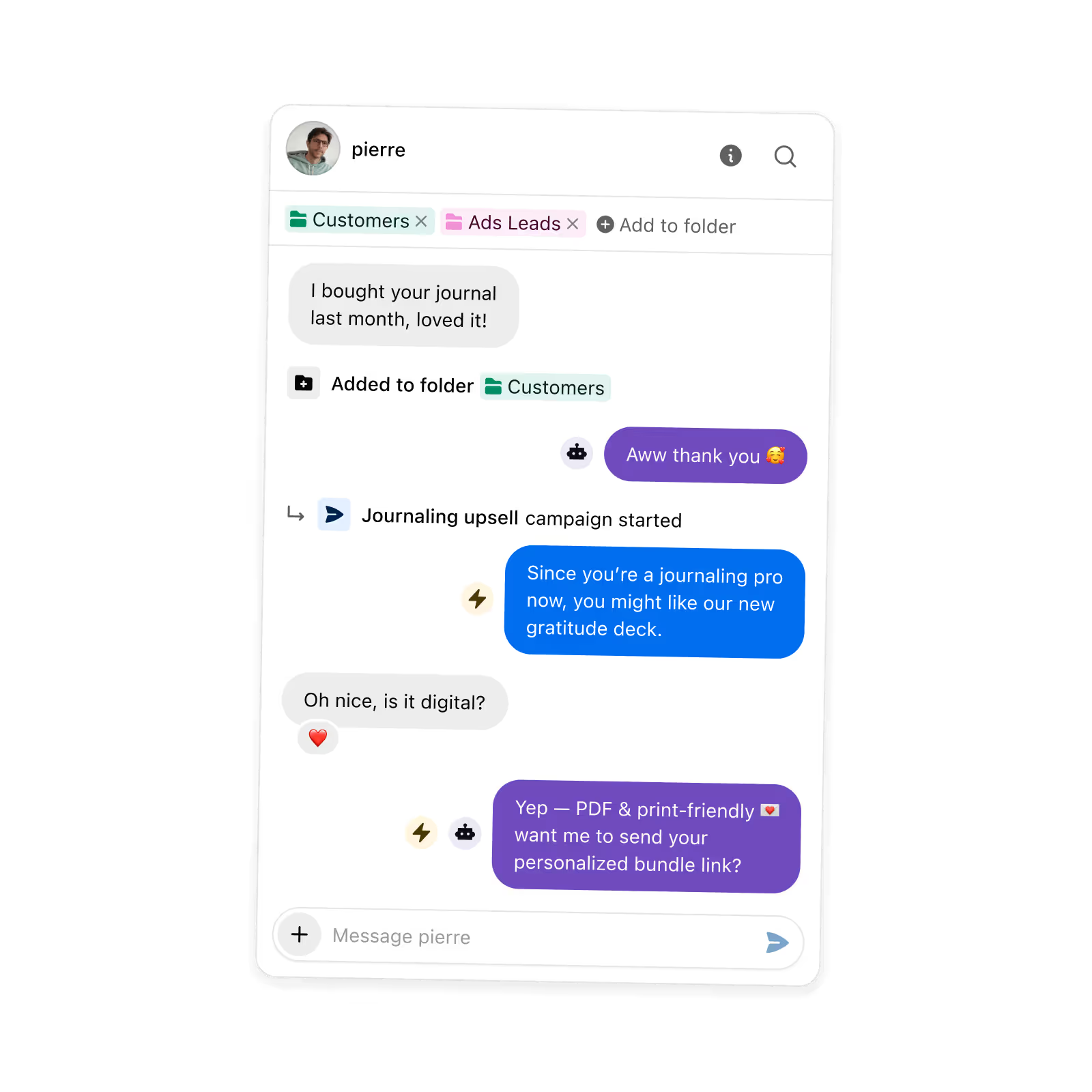
Yes, and that is what Inrō's AI agent does: it asks your questions one at a time, reads the reply, files the person into a folder and routes them to the next step. The scale is the point. One Harvey Growth campaign run on Inrō reached 7,419 contacts and flagged 1,537 of them as interested, which is a qualification pass no one was going to do by hand. Meta's platform policy requires automated chat experiences to disclose that a person is interacting with an automated service, so say it once at the start of the thread and then get on with the questions.
What if they answer in one word?
A one-word answer is still an answer, and it is usually a real signal. "Soon" to a timeframe question means they have no date, which is a soft no. "Not sure" to a budget question at a high price band usually means nobody has approved anything yet. The mistake is to repeat the question. Move to the next screen instead, and let the pattern across three or four answers do the sorting rather than any single reply. If every answer is one word, you have learned the most useful thing available: this person is not engaged enough to be worth a call yet.
Yes, free with no sign-up, no email gate and no limit on how many sets you build. The generator runs entirely in your browser, so your offer type, price band and screens never leave your device and nothing is stored. Copy the whole set with one button or copy any single question with the button next to it. If you then want the questions asked for you rather than by you, Inrō's free plan covers 100 active contacts, three campaigns a month and three active automations, which is enough to run one qualification flow end to end before you decide whether to pay for anything.
Kshitij runs the growth experiments and looks after client success from first trial to enterprise rollout at Inrō. The advice in these tools comes from funnels he has tested on real accounts, and from the support tickets that follow when a setup goes wrong.