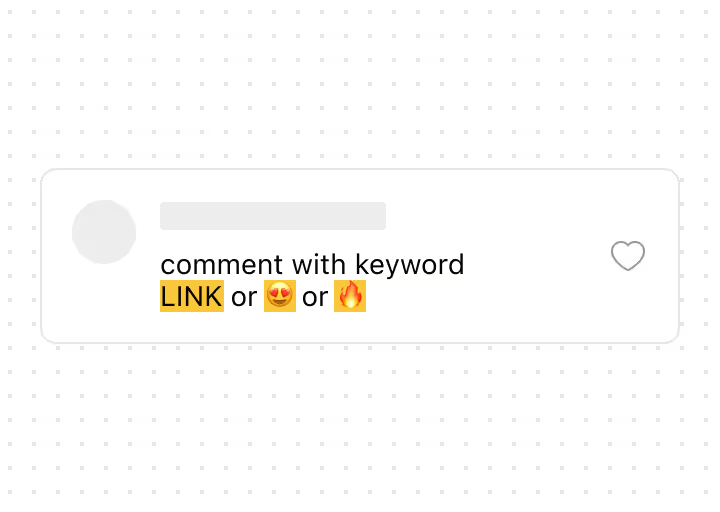
Write your comment-to-DM caption
What is a comment-to-DM caption and how does it work?
A comment-to-DM caption is an Instagram caption that asks readers to comment one specific word so an automation can send them a direct message in return. Meta's Instagram Platform documentation defines the mechanic underneath it: a professional account can send one private reply to a person who comments, within seven days of that comment.
The caption is the only part of that chain you write. The rest of the chain follows a pattern we see across Inrō campaigns: 60 to 80 percent of triggered DM recipients open the message, 30 to 50 percent reply or click a link, and 15 to 25 percent become qualified leads. Setting the automation up is a separate job that lives on the Inrō comment-to-DM page.
How the generator works
- Name the offer. Write what you are giving away the way you would say it out loud to one person.
- Pick one trigger word. The generator rejects spaces, punctuation and anything over 14 characters, because those are what break matching.
- Read four versions. Each formula opens differently, repeats your trigger word, and counts itself against Meta's documented limit.
The anatomy of a comment-to-DM caption
Why four formulas beat one caption
- Four openings, one ask. Curiosity, direct exchange, proof and question all end in the same trigger word, so you can test the hook without touching the mechanic.
- A character count per version. Each one counts itself against Meta's 2,200-character cap, so you find out here rather than in the app.
- No invented follow rule. Every caption tells non-followers to check their message requests, which is where the private reply lands, per Meta's private-replies docs.
- A proof line you have to fill. The proof-led version ships with an empty bracket, not a borrowed statistic. One creator's version of that number: parent-coaching creator Kidnest captured 2,000 comments and 100 direct sales from one post.
What caption guides claim, and what Meta documents
Six rules turn up in almost every comment-to-DM caption guide. Here's where each one comes from, with links to Meta's documentation where it exists.
Documented means Meta publishes the rule. Contradicted means Meta's own docs say the opposite. "Not documented" means Meta doesn't publish this anywhere.
Handling DMs by hand vs automating with Inrō
Manual DM management
Just answering as fast as you can
Warmest leads go cold before you reply
Miss everything while you're offline
No lead capture or CRM tagging
Engagement rarely turns into sales
Inrō automation
Instant replies + lead capture
Auto-reply to every comment in seconds
Works 24/7, never miss a follower
Every lead tagged in Smart Inbox & CRM
Turns engagement into booked revenue
Start free with Inrō
Making the trigger land
- Say the word three times. Put it in the caption, in your own pinned first comment, and on screen if the post is a Reel.
- Tell people where to look. Meta's own docs put the private reply in the Request folder when the person does not follow you.
- Avoid words people already type. A trigger like LINK or YES fires on ordinary comments and sends DMs to people who never asked.
- Give the word one job. One post, one word, one thing it delivers, so a comment on an old post cannot pull today's link.
Where this caption loses the comment
Asking for two actions
A caption that wants a comment and a save and a share splits the one behaviour your automation needs.
Shipping it unedited
These are assembled from fixed wording, so a caption you haven't rewritten reads like every other caption built the same way.
Borrowing someone else's number
The proof line ships as an empty bracket because a statistic you cannot show is the fastest way to lose the comment.
A comment-to-DM caption has one job: make one word feel like the obvious next move. Write the hook for your audience, keep the trigger short and unusual, repeat it once, and tell people who do not follow you to check their message requests.
Set the word as a trigger
Paste your caption, set the same word as a trigger in Inrō, and the DM sends itself on Meta's official API. The free plan covers 100 active contacts a month, 3 automations, 3 campaigns and 50 AI credits.
Start for free
Trusted by 10,000+ creators and brands
, including Walmart & Yoyomatch
Frequently asked questions
What is a comment-to-DM caption?
A comment-to-DM caption is an Instagram caption whose call to action is a single word. You ask readers to comment that word, and an automation sends each of them a direct message in reply. Meta's Instagram Platform documentation calls the underlying feature a private reply: a professional account may send one message to a person who commented, within seven days of the comment. Everything a normal caption has to do still applies: the post has to earn attention before the word does any work. The difference is that the caption is now the front end of a delivery mechanism, and one ambiguous or hard to spell word breaks the whole chain.
What should my trigger word be?
One word, spelled the way people already spell it, and specific enough that nobody types it by accident. The generator enforces three of those rules for you: no spaces, letters and numbers only, and 14 characters or fewer. The reason is mechanical rather than stylistic. A trigger fires on what people type, so a two-word phrase gives them two chances to get it wrong and punctuation gives them more. Words like LINK, YES and INFO look convenient and are among the worst choices available, because people write them in ordinary comments and then receive a message they never asked for. Name the thing you are sending instead.
Where should the trigger word go in the caption?
In the call to action, and once more on its own line at the end. Every caption this tool writes repeats the word exactly twice, and highlights both places so the pattern is visible. The repeat exists because people skim, and because a caption that names the word once, in the middle, loses everyone who read the first line and scrolled on. Put it a third time outside the caption if the post allows it: your own pinned comment is the usual place, and on-screen text works for a Reel. What does not work is burying the word after several unrelated sentences, because the ask stops reading like an ask.
Do people have to follow me before I can DM them?
No, and this is the most repeated wrong rule in the genre. Meta's private replies documentation states where the message goes: the reply appears in the person's Inbox if they follow your professional account, or in their Request folder if they do not. That is a routing difference, not a permission gate. It matters for the caption, because the line asking people to make sure they are following spends words on something Meta does not require. The useful version tells people who do not follow you where to look instead, which is what every caption this tool writes does. Checked against Meta's documentation on 2 August 2026.
How long can an Instagram caption be, and where does 2,200 come from?
Every caption tool repeats 2,200 characters and almost none of them link to anything. Instagram's consumer Help Center doesn't publish a caption length at all. The number is real, but it comes from Meta's developer documentation: the Instagram Platform media reference caps captions published through the API at 2,200 characters, 30 hashtags and 20 @-mentions (API v25.0). The 125-character truncation point those same articles quote appears nowhere in Meta's documentation.
Will everyone who comments get the DM?
Only the people whose comment matches your trigger. That is why the word matters more than the rest of the caption: an automation reads what was typed, not what was meant, so a comment saying send me the calendar may not match CALENDAR unless the tool is set to match loosely. Deleted comments, closed accounts and people who have blocked you drop out too. Meta's rules add two more boundaries: one private reply per comment, and seven days from when the comment was made. Assume a share of your commenters never receive the message, and make the word easy to copy, which closes most of that gap.
How do I actually send the DM?
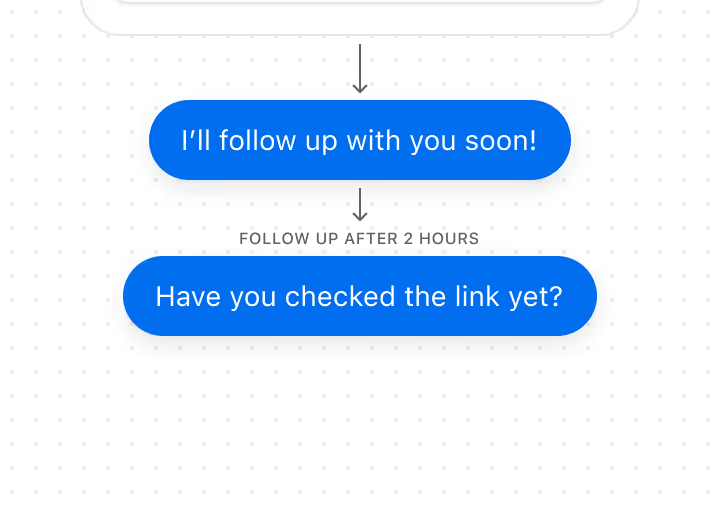
The caption asks for the comment; something else has to answer it. Meta allows one private reply per comment through the Instagram Platform API, and DM automation tools are built on that permission. You set the same word you used in the caption as a trigger, write the message it sends, and connect an Instagram professional account. Inrō does this and publishes that it sends one DM per user per post by default, which stops one person being messaged repeatedly when they comment more than once. You can also reply by hand. The seven-day window and the volume of a post that works are why most people automate it.
How are these captions generated?
The page assembles them from four fixed formulas written by hand, using the words you type. Nothing is sent anywhere, no language model is involved, and the same inputs always produce the same four captions. That is deliberate for a first version, because a template you can read is easier to trust and to edit than a paragraph that arrived from somewhere else. The trade-off is real. The wording is fixed, so two people with similar offers get similar captions, which makes these drafts a starting structure, not a finished post. Rewrite the hook in your own voice before you publish and keep the parts that carry the mechanic.
Is it free, and do you keep what I type?
It is free, there is no sign-up, and nothing you type leaves your browser. The captions are assembled by a script on this page, so the offer, trigger word and audience you enter are never sent to a server and are gone when you close the tab. There is no cap on how many captions you generate and no watermark on what you copy, so use the output anywhere, including inside another tool. The one thing this page cannot do is set the automation up for you, because that needs a connected Instagram professional account. The free Inrō plan covers 100 contacts and 3 automations if you want to test it.
Kshitij runs the growth experiments and looks after client success from first trial to enterprise rollout at Inrō. The advice in these tools comes from funnels he has tested on real accounts, and from the support tickets that follow when a setup goes wrong.