Write your Instagram hook
How long do you really have to hook a viewer?
An Instagram hook is the opening line of a Reel, carousel or caption, the words that tell someone what they are about to get before they decide whether to stay. Every guide gives you three seconds to land it. Meta has never published a study behind that number.
We checked the eight most popular hook generators and hook lists in August 2026. All eight repeat a first seconds claim. None links a primary source for it. None labels the pattern on the hook it hands you. One gives a length rule. This tool builds every line from twelve named patterns, prints the pattern, and measures the line against the format you picked.
How this generator works
- Name the subject. Type your topic and the audience you are talking to, both in your own words.
- Pick the surface. Reel, carousel or photo post, which sets the pattern order and the length rule applied.
- Pull one lever. Curiosity, stakes, specificity or contrarian rewrites all twelve lines while the patterns stay put.
How the twelve hooks are built
Why a labelled hook beats a generated one
- Every line names its pattern. You see which of the twelve shapes produced each hook, so when one works you know what worked.
- A length rule per surface. Twelve words for a Reel, sixty characters for slide 1, 125 for a caption first line.
- It flags its own output. Two of the twelve hooks it ships with are marked too long to say in one breath.
- Nothing is generated. Forty eight written templates, with your words dropped in unchanged. The same inputs always return the same twelve lines.
Where the three second rule comes from
Four sources get welded into one rule of thumb. Only the last is about hooks.
Both Facebook pages no longer load; the two studies everyone cites survive only in the Internet Archive captures linked above.
Handling DMs by hand vs automating with Inrō
Manual DM management
Just answering as fast as you can
Warmest leads go cold before you reply
Miss everything while you're offline
No lead capture or CRM tagging
Engagement rarely turns into sales
Inrō automation
Instant replies + lead capture
Auto-reply to every comment in seconds
Works 24/7, never miss a follower
Every lead tagged in Smart Inbox & CRM
Turns engagement into booked revenue
Start free with Inrō
Check these before you film
- Set an expectation you can meet. Mosseri's reel of 4 October 2024 praised hooks that use text and set expectations for what follows.
- Put the hook on screen. Most feeds start muted, so a spoken hook alone reaches only the people with sound already on.
- Replace every number. The templates carry placeholder figures, and a borrowed number is the fastest way to lose a comment section.
- Test the shape, not the line. Run one pattern across three posts before you decide whether that shape works for you.
What a bad hook costs you
Promising more than the post
A hook that oversells earns one scroll now and teaches your audience to skip the next thing you publish.
Posting the placeholder numbers
The templates carry invented figures, and a number you cannot back turns your comment section into a cross examination.
Testing lines instead of shapes
Unlabelled hooks tell you that a line worked. Labelled ones tell you which pattern worked, which is the reusable part.
Nobody at Meta has published a study showing you lose a viewer at second four. What the Head of Instagram did say, on 4 October 2024, is that hooks which set an expectation work, and that you should test different types. Twelve named patterns is where testing starts.
Turn the hook into a conversation
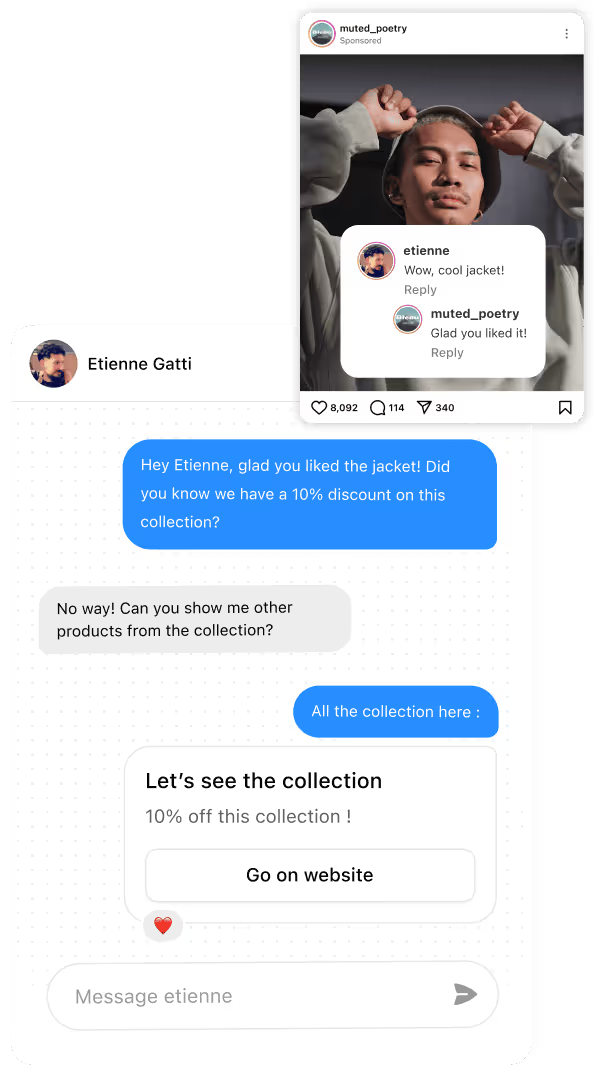
A hook that lands fills your comments. Set a keyword trigger and every one of those comments gets a DM in seconds. The free plan covers 100 active contacts a month, 3 automations, 3 campaigns and 50 AI credits.
Start for free
Trusted by 10,000+ creators and brands
, including Walmart & Yoyomatch
Frequently asked questions
What makes an Instagram hook work?
A hook does one job. It tells someone what they are about to get, before they decide whether to keep going. Adam Mosseri, the Head of Instagram, put it in a reel on 4 October 2024: the best hooks he has seen "use text and set expectations for what you're about to see". That is the whole brief. A hook that sets an expectation the post then meets earns the watch. One that promises something the post never delivers earns a scroll and teaches your audience to skip the next one. The twelve patterns here are twelve ways to set that expectation.
Where does the first three seconds rule come from?
Three separate things, and none is a study of hooks. Three seconds is Meta's ad counting threshold: its Business Help Center defines a 3-second video play as a video that "played for at least three seconds, or for nearly its total length". The 47 percent figure everyone quotes comes from Facebook's "The Value of Video for Brands", 17 March 2015, where Nielsen analysed 173 BrandEffect studies and found that people who watched under three seconds still created up to 47 percent of campaign value. That is an argument that short views count, not a deadline. Mosseri then said on 4 October 2024 that the first three seconds are "super important", with no number attached to it.
How long should an Instagram hook be?
There is no published limit, so this tool judges every hook against the surface you picked and names the rule it is applying. A Reel hook is scored on words, twelve or fewer, because it gets spoken in roughly one breath. A carousel hook is scored on characters, sixty or fewer, because slide 1 is often first seen at thumbnail size. A caption first line is scored against 125 characters, where guides say the feed folds the rest away. The first two are our own rules. Only the 125 figure comes from anywhere else.
Does this hook generator use AI?
No. Every hook comes from a written template, and the same four inputs always return the same twelve hooks in the same order. Twelve named patterns and four levers make forty eight templates, and your topic and audience drop into them unchanged. Nothing is sent to a model, nothing leaves your browser and nothing is stored. That is a choice rather than a shortcut. An AI hook writer will hand you a line with a number in it that you never earned, and nothing tells you the number was invented. A template that prints its own pattern name is easier to check.
What is the difference between a pattern and a lever?
A pattern is the shape of the sentence. A lever is the reason anyone would care about it. Question, Open loop, Numbered list, Negative command, Comparison, Confession, Direct address, Conditional, Overheard, Time frame, Ranking and Objection are shapes. They describe grammar, not feeling. Curiosity, Stakes, Specificity and Contrarian are levers. They describe what the sentence withholds, what it threatens, what it quantifies or what it contradicts. Keeping the two apart is the point of the tool. Most hook lists mix them, so a curiosity gap and a question end up as siblings when one is a motive and the other is a grammar. Change the lever here and all twelve shapes stay put while every sentence gets rewritten.
Why does it say the numbers in the hooks are placeholders?
Because they are. The Specificity lever produces lines such as "It takes eleven minutes" and "The best advice I ever got was four words long". Those numbers come from the template, not from your work, and posting one unchanged would be a claim you cannot back. The widget says so in its own note instead of hiding it. This is the failure mode of AI hook writers that is easiest to miss. They emit confident specifics because specifics perform, and the interface never flags which specific was invented. Replace every number in a hook with one you can point at. A line carrying your real figure beats a borrowed one, and it is the only version you can defend in the comments.
Should the hook be on-screen text or spoken?
Both, and they do not have to be the same words. Mosseri's reel of 4 October 2024 singled out hooks that "use text and set expectations", which is a vote for putting it on screen. In practice the text hook has to survive being read with the sound off, and the spoken hook has to survive being heard while someone glances away. That is why this tool scores a Reel hook on words rather than characters. Twelve words is roughly one spoken breath, a constraint the on-screen version does not have. If only one of the two can carry it, make it the text.
Is the hook generator free, and does it store anything?
It is free, there is no account, and there is no email step in front of the results. The whole tool runs inside this page. Your topic, your audience, your chosen format and your lever never leave the browser, nothing is written to a server and nothing is kept between visits. Reload the page and it returns to the example it shipped with. The copy button uses your own browser clipboard. Once you have the opening line, the Instagram Caption Generator on this site builds the three parts that come after it and marks the point where the feed cuts a caption off, so you can see how much of the rest survives the fold.
How many hooks should I test before picking one?
More than one, which is the only instruction the platform itself has given. Mosseri's reel of 4 October 2024 closed with "try experimenting with different types of hooks to see what works best for you", and that is as specific as Instagram has ever been in public about hooks. Nobody publishes a number, so this page will not invent one. What the tool gives you is twelve at a time, each labelled with the pattern it came from, so when one of them lands you know which shape landed and can write more of that shape yourself. Testing unlabelled lines tells you that a line worked. Testing labelled lines tells you why it worked.
Kshitij runs the growth experiments and looks after client success from first trial to enterprise rollout at Inrō. The advice in these tools comes from funnels he has tested on real accounts, and from the support tickets that follow when a setup goes wrong.


.png)