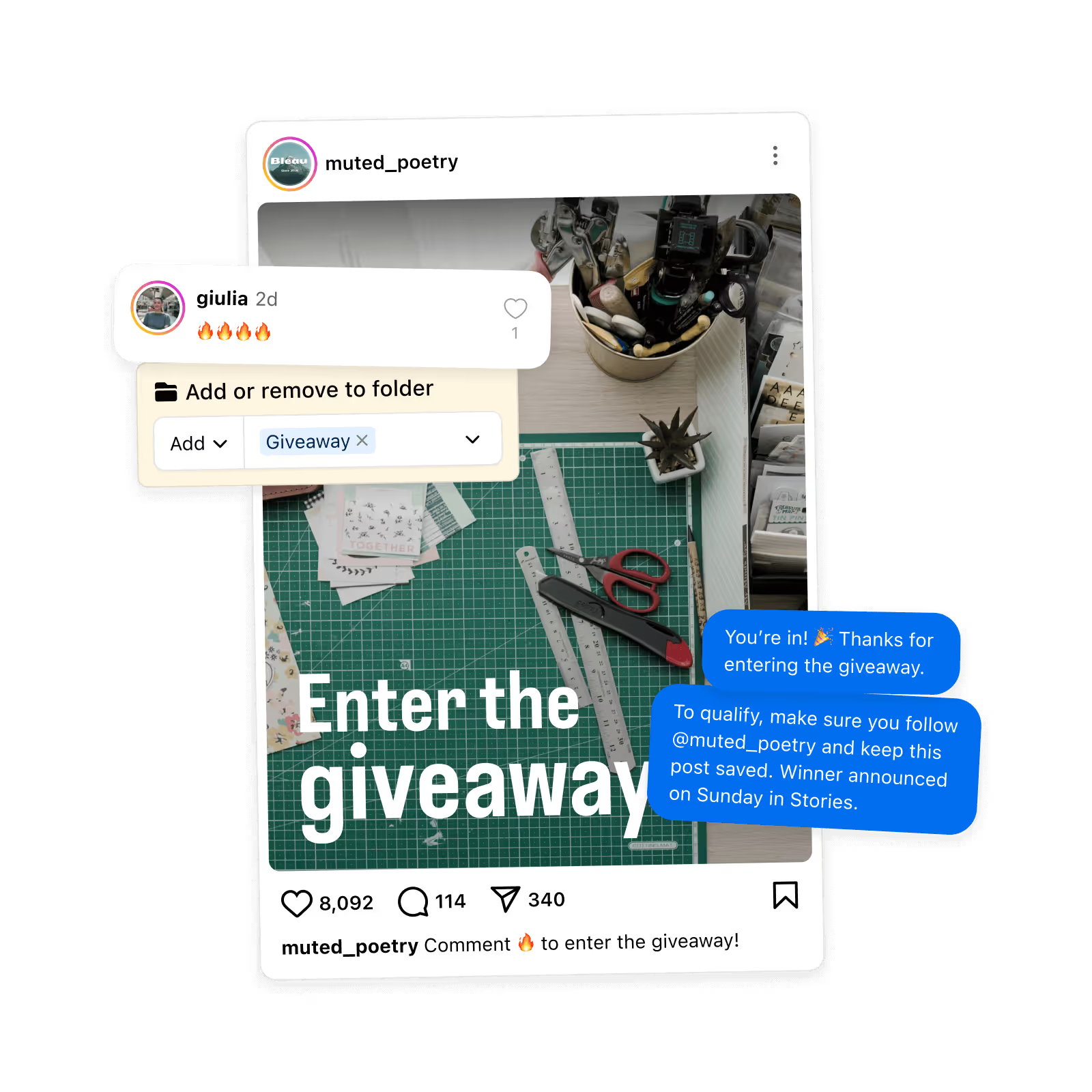
Pick your giveaway winners
How do you pick a fair Instagram giveaway winner?
An Instagram giveaway comment picker is a tool that takes the comments on a giveaway post, removes the entries that do not qualify, and selects winners at random. This one runs in your browser and can't read Instagram, so you paste the comments in yourself. The paste is the trade: fetching comments automatically needs an Instagram login or a paid connection to Meta's API, and a free page with no sign-up has neither.
What it adds is a draw you can prove. Every draw uses a seed, a short word you choose and publish. Anyone holding your entry list and your seed can run the same draw and get the same winners. A certificate shows that a draw happened. A seed lets anyone repeat it.
How to run the draw
- Paste your comments. Copy them from the post, one per line; the first word of a line becomes the handle.
- Set your rules. Remove duplicate handles, require your keyword, require tagged friends, and exclude your own accounts.
- Publish the seed. Save the seed with your entry list, and anyone can re-run your draw and check it.
How the winner gets picked
What a replayable draw gets you
- Answer the accusation directly. When someone says the draw was rigged, hand them your list and your seed and let them run it themselves.
- No login, no upload. The comments never leave your browser. No account gets connected, and no entrant list sits on someone else's server.
- Rules you can state up front. Publish your keyword, tag count and exclusions before the draw, then apply exactly those and nothing else.
- Backups without a second draw. The order after the winners is already fixed, so an unreachable winner is replaced without touching the seed.
What free giveaway pickers actually give you
Every cell comes from the tool's own pages, August 2026. Free tier means what a first-time visitor gets without paying:
Two notes on precision. AppSorteos and ExportComments do not publish their paid prices. ExportComments is the only tool here whose pages describe a seed, and no example verification link appears on its site; treat that row as its claim.
Handling DMs by hand vs automating with Inrō
Manual DM management
Just answering as fast as you can
Warmest leads go cold before you reply
Miss everything while you're offline
No lead capture or CRM tagging
Engagement rarely turns into sales
Inrō automation
Instant replies + lead capture
Auto-reply to every comment in seconds
Works 24/7, never miss a follower
Every lead tagged in Smart Inbox & CRM
Turns engagement into booked revenue
Start free with Inrō
Before you draw
- Write the rules into the post. Meta's promotions policy makes you responsible for the official rules, offer terms and eligibility. Put them where entrants read them.
- Say Instagram is not involved. The same policy requires entrants to acknowledge the promotion is not sponsored, endorsed or administered by Meta, and to release Meta from liability.
- Announce the seed before you draw. A seed published in advance cannot be swapped afterwards, which is what turns a claim of fairness into something checkable.
- Save the entry list too. A seed proves nothing without the exact list it ran on, so keep both in the same place.
Not legal advice. Meta's policy wording above is current to August 2026, and giveaway rules differ by country and by prize.
Where a draw loses trust
Redrawing until you like it
Nothing reads as rigged faster than a winner who changes, and a published seed makes a quiet redraw visible.
Counting one person twice
A handle that comments five times gets five chances unless you dedupe, and entrants notice who commented most.
Losing the entry list
The seed reproduces a draw only against the exact list it ran on, so a lost or re-sorted list breaks it.
A giveaway draw is only as trustworthy as the part you can hand to someone else. Publish the entry list and the seed, and anyone who doubts the result can run it again and land on the same name.
DM the winner and every entrant
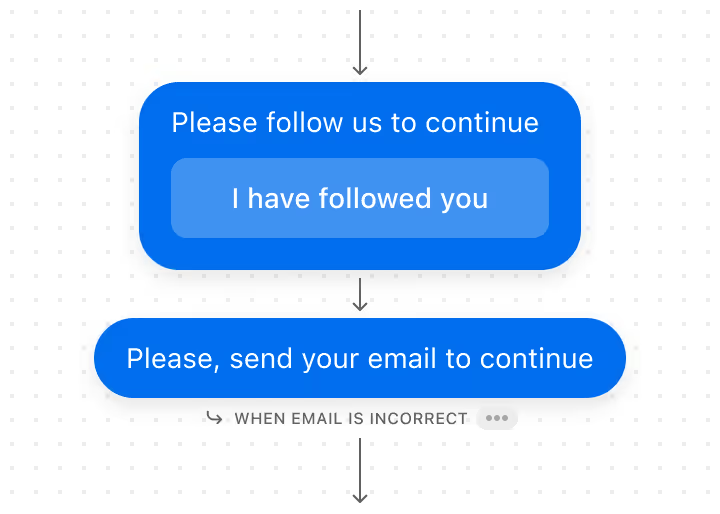
Inrō answers every giveaway comment with a DM in seconds, keeps each entrant as a contact, and announces your winner. The free plan covers 100 active contacts a month, and Inrō is a Meta Tech Provider.
Start for free
Trusted by 10,000+ creators and brands
, including Walmart & Yoyomatch
Frequently asked questions
How do I pick a random Instagram giveaway winner?
Open the picker above, replace the sample with your own comments, and read the winner off the green card. In order: copy the comments from your giveaway post and paste them one per line, decide whether a handle gets one entry or one entry per comment, add your entry keyword or a minimum number of tagged friends if you used those rules, list any handles to exclude, then set how many winners and how many backups you want. The seed field decides the draw itself. Leave it as it is or type a word of your own, and save that word alongside your entry list. Anyone holding both can run the draw again and get your winner back.
Is the draw fair, and can I prove it?
Fair and provable are two different problems, and most pickers only solve the first. The shuffle here is a Fisher and Yates shuffle, which gives every entrant in the pool the same chance of landing in any position. That is the fairness part, and it is unremarkable. The provable part is the seed. The generator behind the shuffle reads nothing except your seed text, so it has no clock, no counter and no hidden state. Publish your entry list and your seed and any doubter can reproduce the draw in order, winners and backups alike. A certificate or a recorded video shows that a draw took place. A seed lets the person who doubts you repeat it themselves.
Why does this tool not fetch the comments for me?
Because doing it honestly costs something a free ungated page cannot pay. Reading a post's comments through official means runs through Meta's API, which needs the post to come from a professional account and that account connected by a Meta login. The tools that fetch comments do exactly that, and they charge for it. Checked on their own pages on 2 August 2026: Comment Picker caps free users at 100 comments per post and requires an Instagram business or creator account; AppSorteos caps its free tier at 300 comments. Scraping around the API is the other route, and we will not take it. Pasting is slower, and it is the only version of this that stays free, leaves your account unconnected, and stores nothing.
Can I require entrants to tag two friends?
The tool supports it. Set Minimum friends tagged to 2 and every comment with fewer than two @ mentions after the entrant handle drops out. Whether you should use that rule is a separate question. Meta's Pages, Groups and Events policy, in the Promotions section as published in August 2026, states that your promotion must not require or incentivize participants to share, repost, tag others, or in any other way publicize your promotion. That wording is broader than the older version of the same policy, which restricted specific mechanics on personal timelines. Meta also announced in December 2017 that posts using engagement bait to boost reach would be shown less in feed. The filter exists because people ask for it; the policy text is here so you can decide with it in front of you.
What do Meta's own giveaway rules actually say?
Harder to answer than it should be. Instagram's own Promotion Guidelines sit at help.instagram.com/179379842258600. Fetched on 2 August 2026, that page returned the words Help Center and nothing else, because the policy body is rendered by JavaScript and cannot be quoted from the source. What is readable is Meta's Pages, Groups and Events policy, and two versions of it are live at once. The legacy page, stamped Last Revised March 8, 2018, says promotions must include a complete release of Facebook and an acknowledgement that the promotion is in no way sponsored, endorsed or administered by Facebook. The current Policies Center version shows no revision date, says the same about Meta, and adds the restriction on requiring or incentivizing sharing and tagging. Meta's developer platform policy, updated 3 February 2026, links to the Policies Center version, so that is the one quoted here.
Do I have to disclose anything when I run a giveaway?
This is not legal advice, and the answer depends on where you and your entrants are. What is quotable is the United States rule, because it is written down. The Federal Trade Commission's Endorsement Guides, 16 CFR 255.5, name the chance of winning as a connection that has to be disclosed: material connections can include the possibility of being paid, of winning a prize, or of appearing on television or in other media promotions. The same section says a disclosure is needed when a significant minority of the audience does not understand or expect the connection. That lands on entrants as much as on you, since an entry post is an endorsement they were incentivized to make. Read the current text at govinfo.gov, and check your own jurisdiction.
Can I draw several winners and backups at once?
Yes, and they come out of one draw rather than several. Set Winners to the number of prizes and Backups to how many reserves you want. The shuffle produces a single ordered list of everyone in the pool; the winners are the first names in that order and the backups are the ones immediately after. Because the order is fixed by the seed, a backup stepping in is not a new draw, and nobody has to take your word for who was next in line. If you ask for more winners than there are entrants, everyone qualifies and the tool says so instead of inventing names. If nobody is left over, the backups block simply does not appear.
Do giveaways actually grow your following?
Nobody has published data good enough to answer that, and the numbers you have read are weaker than they look. The most repeated pair, that contest posts get 64 times more comments and grow followers 70 percent faster over three months, traces to a single Tailwind blog post. That post describes its method in one clause, over 60,000 Instagram posts, and links to no dataset, no date range and no definition of a contest post. It was still live in August 2026, and its displayed 2020 date is later than its own first web archive snapshot from July 2017. On what happens afterwards, the only primary source we found is a 2020 Social Media Examiner case study covering six giveaways in one industry, which its author labels an estimate.
Is it free, and what happens to my entrant list?
Free, with nothing gated behind an email address, and no paid tier of this page to upsell you to. Your entrant list never leaves the browser tab. The parsing, the filtering and the shuffle all run in JavaScript on your own device, the page makes no network request while you use it, and nothing about the draw is written to a server or to storage. That also means the page cannot remember a draw for you, which is the trade: save the entry list and the seed yourself, in a note or a screenshot, or the proof is gone when you close the tab. If you want the winner and every entrant messaged afterwards, that is what Inrō does.
Kshitij runs the growth experiments and looks after client success from first trial to enterprise rollout at Inrō. The advice in these tools comes from funnels he has tested on real accounts, and from the support tickets that follow when a setup goes wrong.