Is there a best time to post on Instagram?
There is no single best time to post on Instagram, and the studies that publish one disagree by up to fourteen hours on the same weekday. Later puts Wednesday's peak at 3 a.m. Hootsuite puts it at 5 p.m. Both were published in 2026, both say their times are already localised, and both analysed millions of posts.
The spread is not sloppiness. Each study samples a different population, defines engagement differently, and handles time zones its own way. The table below carries all three columns; check which study, if any, measured an audience like yours. Instagram itself names no recommended hour.
How to build your posting plan
- Read your Insights. Open your professional dashboard, tap Total followers, and note the two hours your followers are most active.
- Set your cadence. Enter how many posts you publish a week and which format you post most.
- Run the test. Post in alternating windows for two weeks, then compare the two sets on the same metric.
Why test your own windows
- Your own data wins. Every study on this page says the same thing in its own words: check your account before trusting its averages.
- A test beats a guess. Two weeks of alternating windows gives you a comparison on your own posts instead of a median from someone else's accounts.
- The same weekdays in both windows. That removes the weekday from the comparison, so what you measure is the hour and nothing else.
- Replies don't wait for you. Inrō answers a story reply within seconds, usually under 10. A post's hour stops deciding when someone hears back.
What each study says, and what it measured
Six studies and the platform itself, with the population, metric and time zone behind each:
Read the fourth column before the fifth. Two of them measure when people engaged, not how posts published at that hour performed. One stripped time zones out first.
Handling DMs by hand vs automating with Inrō
Manual DM management
Just answering as fast as you can
Warmest leads go cold before you reply
Miss everything while you're offline
No lead capture or CRM tagging
Engagement rarely turns into sales
Inrō automation
Instant replies + lead capture
Auto-reply to every comment in seconds
Works 24/7, never miss a follower
Every lead tagged in Smart Inbox & CRM
Turns engagement into booked revenue
Start free with Inrō
Before you reschedule
- Check the time zone column first. CoSchedule's page says its data was cleaned to a 24 hour format regardless of time zone, so its 9:01 AM is not anyone's local hour.
- Match the format across both windows. Post Reels at one hour and photos at the other and you have measured format, not time.
- Use medians, not averages. One post that travels drags an average for weeks, and two weeks is not long enough to absorb it.
- Keep the window you can hold. A slightly worse hour you post at every week beats a better one you miss half the time.
How this test can mislead you
Changing two things at once
Switching format, caption style or hashtags mid test means the result belongs to that change, not to the hour.
Reading a small gap
Two weeks of posts is a small sample; a narrow difference between windows is noise rather than an answer.
Testing hours you cannot keep
A 5 a.m. window that wins once is worthless if you won't schedule for it every week.
No universal best hour exists. Five 2026 studies of millions of posts each name a different peak, and two sit fourteen hours apart on the same weekday. Start from the active hours in your own Insights, then test two against each other.
Answer them the moment they reply
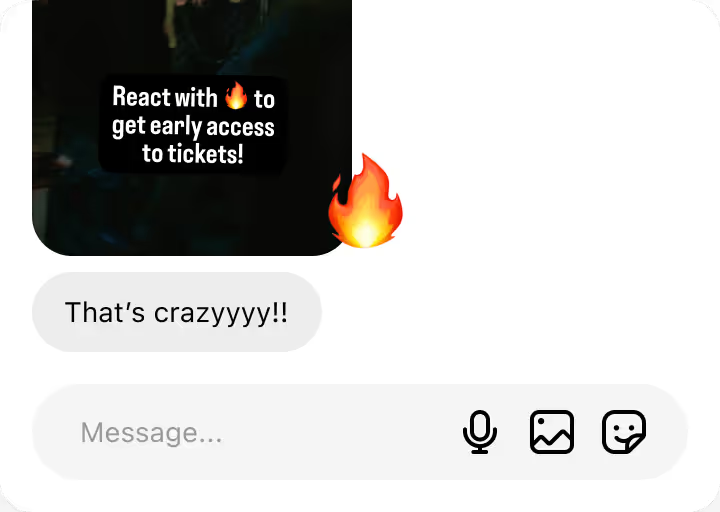
Inrō replies to story replies and comments automatically on Meta's official API. The free plan covers 100 active contacts a month, 3 automations, 3 campaigns and 50 AI credits.
Start for free
Trusted by 10,000+ creators and brands
, including Walmart & Yoyomatch
Frequently asked questions
What is the best time to post on Instagram?
There is no single answer, and the six sources on this page prove it. Later says 5 AM. Buffer says Thursday at 9 a.m. Sprout Social says midday to early evening on Tuesdays and Wednesdays. Hootsuite says 5 p.m. on Wednesdays. Metricool says 8 p.m. Instagram publishes no recommended hour. Each was measured on different accounts, with a different definition of engagement and a different approach to time zones, so they are not answering one question. The useful version is narrower: which of the hours your followers are already active is better for you? Two weeks of alternating posts will tell you.
Why does every study give a different best time to post?
Three reasons, all visible in the table above. First, population: Buffer measured 9.6 million posts from its own customers, Sprout Social measured 30,000 of its customers across six platforms, and Metricool measured 24 million posts from its own users. Different account mixes produce different peaks. Second, metric: Buffer ranks slots by the median engagement rate of posts published in them, while Sprout and Metricool rank hours by how much interaction happens in them. Those are different questions. Third, time zones: Later normalises to the audience's local zone, Hootsuite localises across 118 countries, and Metricool's page never says. A time with no time zone attached cannot be scheduled.
Where does the post at 9 a.m. on Wednesday advice come from?
From one page, and it is worth reading its own methodology. CoSchedule's Best Times To Post On Instagram names 9:01 AM as the top slot and Wednesday as the top day. It was published in February 2024 and updated in July 2024, and describes its data as proprietary research conducted in mid-2022. Two things are missing. No sample size appears anywhere on the page: no post count, no account count, no survey size. And the methodology says the data was cleaned to a neat 24-hour format regardless of time zone, so the hours were detached from any location. The page then tells you to apply them in your audience's time zone.
How do I find my own best time to post on Instagram?
Instagram tells you, free, inside the app. Open your profile, tap Insights or your professional dashboard, tap Total followers, then scroll to Most active times and switch between Hours and Days. Instagram's help centre states that this appears once you have at least 100 followers. That chart is not an answer on its own, because it shows when people are on Instagram rather than when your posts do well. Treat the two tallest bars as candidates, then test them against each other. The planner above turns those two windows into a two week schedule that gives each the same posts on the same weekdays.
What is the best day to post on Instagram?
The studies disagree here too, though less wildly than on hours. Buffer, from 9.6 million posts, names Wednesday the best day and Friday and Saturday the worst. Sprout Social names Tuesday and Wednesday, and says weekends are lowest overall. Hootsuite names Monday, Tuesday and Thursday for reach. Later names Monday. Metricool says Wednesday leads, then adds that Saturdays are as busy as weekdays, which contradicts the weekend rule everyone else reports. Weekday matters less than most schedules assume, and it is easy to confuse with the hour. That is why the plan above gives every posting day one slot in each window.
Does posting time still matter now that the feed is ranked?
It matters, but not the way the old advice implies. Instagram's feed is ranked rather than chronological. Its own explainer, published by Adam Mosseri, says Feed starts from recent posts shared by the people you follow, then reorders them using thousands of signals. One of those signals is when a post was shared. Another is how quickly people are liking, commenting, sharing and saving it. That second one is where timing earns its keep: posting while your followers are around gets a post its first interactions faster. It is one signal among many, and the studies measuring it cannot agree on which hour delivers it.
How long should I test posting times for?
Two weeks at your normal posting rate, which is what this planner schedules. Two weeks gives each window the same number of posts on the same weekdays, so neither the day nor the volume can explain the difference. If you post fewer than three times a week, each window collects fewer than three posts, which is too few to read; run the same pattern over four weeks instead. Keep everything else fixed while it runs. Changing format, caption style or offer mid test hands the result to that change instead of the hour. Compare medians, because one post that travels drags an average for the whole fortnight.
Does this planner read my Instagram account?
No. Nothing is connected, nothing is logged in, and nothing is sent anywhere. The planner runs entirely in your browser, and the only information it has is what you type into the five fields. The two windows you enter are meant to come from your own Instagram Insights, which is the one dataset on this subject that describes your actual followers. Instagram makes it available free to public accounts under Total followers, with the caveat that its insights only reach back 90 days. Read your two most active windows there, type them in, and your figures stay on your device.
Is this best time to post planner free?
Yes, completely, with no signup and no email gate. The plan appears as soon as the page loads and updates as you change any field, and you can copy it out as plain text for your calendar. Every claim on this page carries a named source and its date, and the table above prints each study's population, metric and time zone method so you can judge them yourself. If you also want the replies handled while you sleep, Inrō's free plan covers 100 active contacts, 3 campaigns and 3 automations a month.
Kshitij runs the growth experiments and looks after client success from first trial to enterprise rollout at Inrō. The advice in these tools comes from funnels he has tested on real accounts, and from the support tickets that follow when a setup goes wrong.


.png)