
Instagram sponsored posts put your content in front of new audiences. Here's what they are, why you're seeing them, how they work, and what paid reach alone misses.
.avif)
Automate Comments and DMs in 5 Minutes
Someone comments on your IG post. They get a DM instantly. You do nothing.

Trusted by 10K+ creators and SMBs


TL;DR
TL;DR
A sponsored post on Instagram is any piece of content, a photo, video, Reel, carousel, or Story, that a brand or creator has paid to promote to a specific audience. It appears in users' feeds, Stories, or Explore page with a small "Sponsored" label beneath the account name.
The label is Instagram's way of indicating that the post was not distributed by the algorithm based on organic merit. Someone paid for it to be there. That does not make it low quality. It means the person or brand behind it chose to invest in getting it in front of people who would not otherwise have seen it.
Sponsored posts are Instagram's main advertising product for businesses. They sit alongside other ad formats, but what sets them apart is their origin: a sponsored post starts as a piece of content and gets amplified with budget behind it. Other Instagram ads are built specifically for advertising from the start and never appear on the creator's own profile.
Organic reach on Instagram has been declining for years, and 2026 marks its lowest point for most account types. The average engagement rate across all Instagram content is 0.48%, down 24% year over year. For every 1,000 followers, a typical post reaches fewer people and generates fewer interactions than it did in 2023.
Two things are driving this. First, the platform is more saturated than at any previous point. More creators, more brands, and now AI-assisted content production mean the total volume of content published daily has outpaced the attention available to consume it. The algorithm cannot surface everything.
Second, Instagram's revenue model depends on paid promotion. The platform has a structural incentive to limit organic reach to a level where paid amplification feels necessary. That is not cynical, it is how the business works, and it is consistent with how every major social platform has evolved.
The result for everyday users is a feed where roughly one in every three to four posts is sponsored. For brands, the result is that building an audience organically alone is an increasingly slow strategy. The brands growing on Instagram in 2026 treat paid and organic as two separate but connected systems, not as alternatives to each other.
Not all sponsored posts work the same way. The label covers two distinct scenarios with different mechanics, different costs, and different uses.
A paid promotional post is your own existing content, boosted with budget so more people see it. You select a post from your profile, click the Boost button or open Meta Ads Manager, choose an audience, set a budget and duration, and Instagram distributes the post beyond your followers.
This is the most common starting point for brands new to Instagram advertising. It is fast to set up, uses content you have already created, and the post continues to live on your profile after the campaign ends. The limitation is flexibility: Boost gives you basic targeting options. Meta Ads Manager gives you access to full audience controls, retargeting, A/B testing, and detailed performance tracking.
A branded content post is a creator's own organic content that a brand has paid them to produce and publish. The post appears under the creator's account with a "Paid partnership with [Brand]" label. The content looks and feels like the creator's normal posts because it is, the brand paid for the product placement and the creator's reach, not the ad placement itself.
Brands can then boost branded content through a feature called Partnership Ads, putting budget behind the creator's post just as they would their own content. This is currently one of the highest-converting ad formats on Instagram because the content carries the creator's credibility rather than a brand's.
Boosting a post and running an Instagram ad both put your content in front of new audiences, but they work differently and suit different situations.
Boosted posts are the faster option. You pick an existing post from your profile, tap the Boost button, set a goal, choose a basic audience, and the promotion goes live. No Ads Manager required. The tradeoff is limited control: you cannot change the post content, you can only target one audience at a time, and placement options are restricted. It is a good starting point if you want to test paid promotion quickly or amplify a post that is already performing well organically.
Meta Ads Manager gives you full control. You can build campaigns from scratch with content that never appears on your profile, define multiple audience segments, run A/B tests, set precise cost controls, and track performance at the campaign, ad set, and individual ad level. If you are spending more than a few hundred dollars per month, or if you are running multiple campaigns for different products or audiences, Ads Manager is the more efficient tool.
The honest summary: if you are just starting with paid promotion on Instagram, boosted posts are fine. If conversion efficiency matters and you are investing real budget, Ads Manager will almost always deliver better return for the same spend.
Creating your first sponsored post takes under 10 minutes using the Boost button. The Ads Manager route takes longer but gives you significantly more control.
Using the Boost button (fastest option):
.avif)
Using Meta Ads Manager (recommended for serious campaigns):
Meta Ads Manager gives you access to custom audiences built from your website visitors or customer lists, retargeting, multiple ad placements across Instagram and Facebook simultaneously, split testing, and detailed reporting at the campaign, ad set, and ad level. If you are spending more than a few hundred dollars per month on Instagram ads, Ads Manager is worth learning.
Sponsored posts are good at one specific thing: getting content in front of people who have never heard of you. They are the reach lever. A well-targeted sponsored Reel can generate thousands of impressions from your exact target audience for a relatively modest budget.
What they are not designed to do is convert that reach. A viewer who sees a sponsored post, finds it interesting, and taps through to your profile has just entered your world. What happens next is determined entirely by what your profile and your engagement system look like, not by the ad itself.
This is where most brands lose the return on their ad spend. They invest in reach, generate genuine interest, and then have no mechanism to capture or follow up with the people that interest reached.
The data reflects this gap. Sponsored posts average 1.8% engagement, compared to 2.3% for organic content. The gap exists because paid reach is broader and less targeted at the individual level. But even 1.8% engagement on a well-distributed sponsored Reel represents significant comment and DM volume from people who were interested enough to interact.
Comments on sponsored posts are high-intent signals. Someone who comments "how much is this?" or "where do I get this?" on a sponsored Reel is not a passive scroller. They saw an ad, engaged with it actively, and asked a buying question. That is a conversion waiting for a response.
Without a follow-up system, those comments receive a reply hours later, or not at all. The buyer moves on. The ad spend generated interest but not revenue.
With Inrō, a comment keyword trigger fires the moment someone comments on your sponsored post. They receive a personalized DM instantly with whatever comes next: a product link, a discount code, a question to qualify their intent, or a booking link. Inrō sends one DM per user per post by default, keeping your account well within Instagram's messaging limits while ensuring every high-intent commenter gets a response before they lose interest.
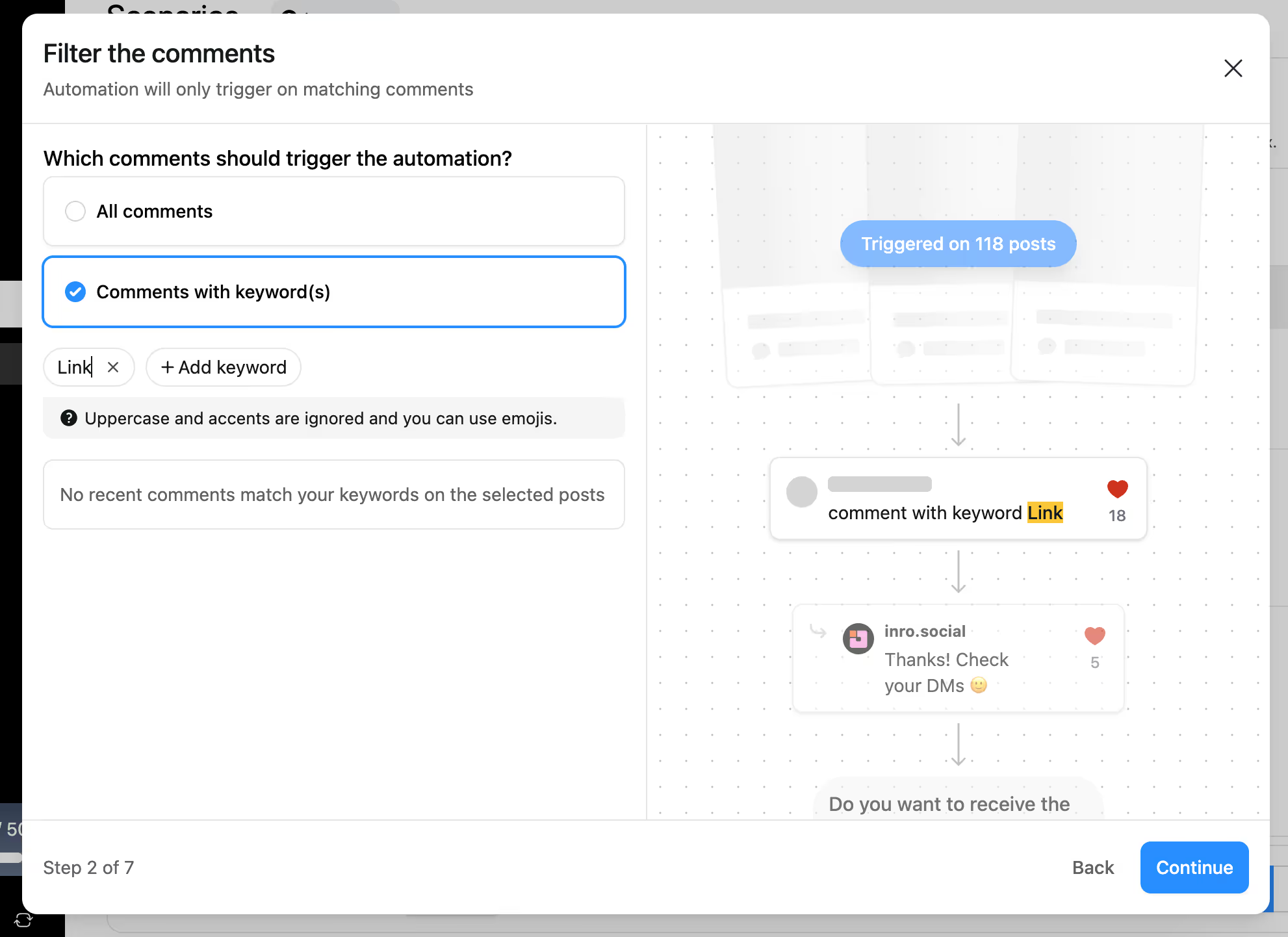
This is the conversion layer that sponsored posts cannot provide on their own. The ad handles the reach. Inrō handles every person the reach touched who then engaged. The comment-to-DM automation guide covers exactly how to set this up before your next campaign goes live.
Set up your first comment-to-DM flow in 5 minutes — no coding, no manual monitoring required.


A sponsored post on Instagram is content that a brand or creator has paid to promote to a specific audience. It appears in users' feeds, Stories, Reels, or Explore page with a "Sponsored" label. The person seeing it does not follow the account that posted it. The post reached them through paid targeting, not the organic algorithm.
Instagram shows sponsored posts to users whose demographics and interests match what the advertiser has targeted. You see them because a brand has paid to reach people like you based on factors like your age, location, interests, or online behavior. The frequency of sponsored posts has increased as more brands invest in paid promotion and organic reach continues to decline.
A regular post reaches your existing followers through the algorithm. A sponsored post is paid to appear in the feeds of people who do not follow you, based on targeting criteria you define. Regular posts are free. Sponsored posts require ad spend paid to Meta.
Any account with an Instagram Business or Creator profile can create sponsored posts. There is no follower minimum. You need a Facebook Page linked to your Instagram account to use Meta Ads Manager, and a payment method on file to run any promotion.
There is no fixed cost. You set your own daily or total budget. The minimum is around $1 per day through the Boost button. The average cost per 1,000 impressions (CPM) on Instagram is $5 to $15. Cost per click (CPC) typically ranges from $0.50 to $3.00. Actual costs vary by audience, industry, competition, and creative quality.
For reach and brand awareness, yes. A well-targeted sponsored post can put your content in front of thousands of relevant people cost-effectively. For direct conversion, results depend heavily on what happens after the reach. Sponsored posts that land on a profile or page without a follow-up system tend to generate impressions without sales. Combining sponsored posts with comment-to-DM automation significantly improves the return on reach by capturing high-intent engagements before they go cold.
A sponsored post is your own content, promoted with paid budget through Meta. A branded content post is a creator's content that a brand has paid them to produce, tagged with a "Paid partnership" label. Branded content looks like organic creator content because it is. Brands can run paid budget behind branded content too, using Instagram's Partnership Ads feature.
Yes. Sponsored posts are Instagram's official advertising product, run through Meta's platform. They are fully within Instagram's terms of service. The only compliance consideration is ensuring your content meets Meta's ad policies, which prohibit certain categories of content and require accurate product claims.
Generally, yes. Sponsored content averages around 1.8% engagement compared to 2.3% for organic content. Paid reach is distributed to broader audiences who are less inherently interested in your account than people who already follow you. That said, engagement volume on a well-distributed sponsored post can still be significant, and comments from users who engaged with paid content represent genuine buying intent worth following up on.
Join automations strategies and Instagram Insights weekly
By entering your email address above and clicking Subcribe, you consent to receive marketing communications (such as newsletters, blog posts, event invitations and new product updates), and targeted advertising from Inrō from time to time. You can unsubscribe from our marketing emails at anytime by clinking on the "Unsubscribe" link at the bottom of our emails. For more information about how we process personal information and what right you have on this respect, please see our Privacy Policy.
Attract more leads, target them with DM marketing, and automate your interactions on Instagram!
.avif)
.avif)
.avif)