
Instagram DM automation tools fall into four types: AI agents, flow builders, multi-channel platforms and comment-to-DM tools. Here is how to choose one.
.avif)
Automate Comments and DMs in 5 Minutes
Someone comments on your IG post. They get a DM instantly. You do nothing.

Trusted by 10K+ creators and SMBs


TL;DR
TL;DR
Start with the free plan
Inrō's free plan includes Instagram automation: 100 active contacts, 3 automations, 3 DM campaigns and 50 AI Agent credits. No credit card.
Most people choosing an Instagram DM automation tool start by comparing features. That is the wrong first step. Tools split into four architectures that solve different problems, and the common regrets (a bill that jumped after a viral post, replies that sound like a bot, an automation that quietly stopped firing) almost always trace back to picking the wrong architecture rather than the wrong brand. Work out which of the four you need first, then compare inside that group.
Instagram DM tools fall into four categories: conversational AI agents, visual flow builders, multi-channel platforms and lightweight comment-to-DM tools. Each trades something away, and the trade is the decision.
An AI agent reads what the person actually wrote and responds to it, instead of matching a keyword to a canned reply. It answers questions from your own documentation, asks a qualifying question, and routes the person to a booking, a checkout or a human.
This is the right category when the same questions arrive every day, when leads come in outside working hours, or when the next step is a call or a sale rather than an email capture. It is the wrong category if all you need is a link delivered.
Tools built around a conversational agent include Chatfuel, DM Champ, TailorTalk, Visito and Inrō. They differ on scope more than on capability: DM Champ is omnichannel and built for agencies to rebrand and resell, Chatfuel covers Instagram, Facebook and WhatsApp from one builder, and Inrō is Instagram-only by design, which is why its triggers reach Live comments, past comments, mentions and click-to-DM ads.
What to check in this category: does the AI learn from your own docs and FAQs or only from general knowledge, can you set escalation rules so it hands off to a human, is there a CRM behind it, and which plan the agent actually starts on. That last one catches people out: on several tools the agent sits two tiers above the entry price.
A flow builder is a flowchart. Someone comments a keyword, the tool sends message one, waits for a condition, then branches. You design each path and the tool executes it exactly.
This suits predictable funnels: a lead magnet with three options, a launch sequence, a structured qualification form. It stops suiting you when the number of flows grows faster than your patience for maintaining them, or when people ask something none of your branches anticipated.
ManyChat, BotPenguin and Drop sit here. ManyChat is the most established in the category and covers Messenger, WhatsApp, TikTok and Telegram alongside Instagram, which is the main reason to choose it over an Instagram specialist.
What to check: whether two flows can collide on the same conversation, whether comment triggers work across Reels, Stories, Lives and ads rather than feed posts only, and how far back in your post history the tool will listen.
These run Instagram as one channel among several, with a shared inbox covering WhatsApp, Messenger, SMS, email and web chat. Respond.io, Tidio, SleekFlow, GoHighLevel and Interakt are in this group.
Choose one when your customers genuinely message you across several channels and the cost of five separate inboxes is worse than the cost of shallower Instagram features. Do not choose one because it lists Instagram on the pricing page. Check whether Instagram support includes comment triggers and Story replies or only inbound DMs, and note that WhatsApp usually carries per-conversation fees from Meta on top of the subscription.
These do one job: someone comments, they get a DM with your link. Setup takes minutes. LinkDM, InstantDM, DropDM, Stan AutoDM and ReplyRush belong here. Several of them, LinkDM and InstantDM included, also automate Facebook comments, which none of the Instagram specialists do.
They are a good fit if your only problem is dropping the same link in comments all day. They become a problem the moment you want to follow up, because the contact usually is not stored anywhere you can act on later. LinkDM has no CRM at all; InstantDM lets you tag inside the flow builder but gives you no inbox to read the thread in. If you expect to nurture the people who comment, you are buying a tool you will replace.
The full list, sorted by category, is on the alternatives hub.
Below are the tools people shortlist most often, listed alphabetically rather than ranked, because the right one depends on the category you settled on above.
Head-to-head detail for each tool sits on its comparison page, and there is a longer ManyChat alternatives breakdown if that is your shortlist.
The headline price is rarely the number that matters. What matters is what the meter runs on, because that decides what happens to your bill in a month when one post does unusually well. Prices below were checked against each vendor's own pricing page in July 2026.
Chatfuel Light is free with no credit card and covers Instagram, Facebook and WhatsApp with a shared inbox, flow builder and segmentation, but no AI. AI PRO is $49 a month, or 29% less billed yearly, and adds the AI sales manager, the knowledge base, broadcasts and lead-qualification funnels. Flat fee, so a viral week does not change it. Chatfuel pricing, checked 8 July 2026.
Credit-based, with every AI action costing a flat 0.25 credits. Starter is $27 a month and covers WhatsApp and web chat only. Instagram unlocks on Growth at $97, with Pro at $297 and Agency at $497. No permanent free plan, only a 14-day trial. Checked 10 July 2026 for the DM Champ comparison.
Free plan covers 100 active contacts, 3 automations, 3 DM campaigns and 50 AI Agent credits, with no card. Pro starts at €12.99 a month with the AI Agent included and unlimited messaging per contact. You are billed on contacts your automations activate in a month, not on contacts stored, and the CRM holds unlimited contacts on every plan. See pricing.
No permanent free plan, only a 7-day trial. Legend Pro is $12 a month and Trendsetter is $29.99, listed at $9.99 and $24.99 billed yearly. Both include unlimited contacts at a flat fee. Worth knowing before you buy the cheaper tier: Advance Account Safety Mode, the Viral Mode handler, follow-up messages and API access all require Trendsetter. InstantDM pricing, checked 8 July 2026.
Free at $0 for 1 Instagram account and 1,000 DMs a month. Pro is $19 a month for 3 accounts and 25,000 DMs. Platinum+ is $99 a month for 10 accounts and 300,000 DMs. The cap is on DMs sent rather than contacts held, so heavy senders hit it before big audiences do. Comment auto-reply, branding removal and email capture require Pro; the pacing controls require Platinum+. LinkDM pricing, checked 8 July 2026.
Five tiers billed on active contacts: Free at 25 contacts, Essential at $14 for 250, Pro at $29 for 2,500, Business at $69 for 7,500 and Advanced at $139 for 25,000. Go past your allotment and you pay roughly $0.10 per extra contact or move up a tier. AI-powered replies start on Pro. WhatsApp carries separate Meta per-conversation fees on top. ManyChat pricing, checked 9 July 2026.
Two patterns are worth pulling out of that. First, the cheapest entry price and the cheapest entry price with an AI agent are different questions, and the gap is large: Chatfuel's agent is $49, ManyChat's is $29, DM Champ's Instagram support starts at $97. Second, per-contact billing and flat billing fail in opposite directions. Per-contact costs more in a viral month and nothing in a quiet one. Flat costs the same either way but caps what you can send. Pick the failure mode you can live with.
Across Inrō's own automations, DMs average a 90% open rate, a 60% reply rate and a 28% click-through rate. Those numbers are the reason DM automation is worth setting up at all, and they are the benchmark to hold any tool to after your first month.
The open rate is the least surprising part. People open DMs. The reply rate is the number that matters, because a reply means the conversation is still alive and something can happen next. If your tool is delivering opens but almost no replies, the message is doing the work of a link dump and you have bought the wrong category.
The honest answer depends on what happens after someone messages you.
Use a tool that connects through Meta's official Instagram API, and start every automation from a message the other person initiated. Those two rules cover most of the risk.
Tools that log in as you through a browser session or a proxy are the ones that get accounts restricted. Official API tools are reviewed by Meta, and a certified Meta Tech Provider has been through that review. Inrō, ManyChat, Chatfuel, LinkDM and InstantDM all run on the official API.
Meta's messaging policies are built around replying to someone who contacted you first, which is why automated cold DMs are the fastest way to get limited. Warm entry points are the compliant version of the same goal: comment-to-DM, Story replies, mentions and inbound keywords all begin with the other person acting first.
Beyond the connection method, check for pacing controls: send delays, comment-ratio limits and wait-for-reply logic. A tool that fires identical messages at machine speed looks like a bot to Meta's systems regardless of which API it uses. Check which plan those controls sit on, too. LinkDM puts its Slow Down Mode and DM queue on Platinum+ at $99, and InstantDM puts Advance Account Safety Mode and the Viral Mode handler on Trendsetter at $29.99, which means the entry tier of both is the tier without the safety net. There is more detail in is Instagram automation safe and on how many DMs you can send.
Seven checks, in the order that has saved the most regret.
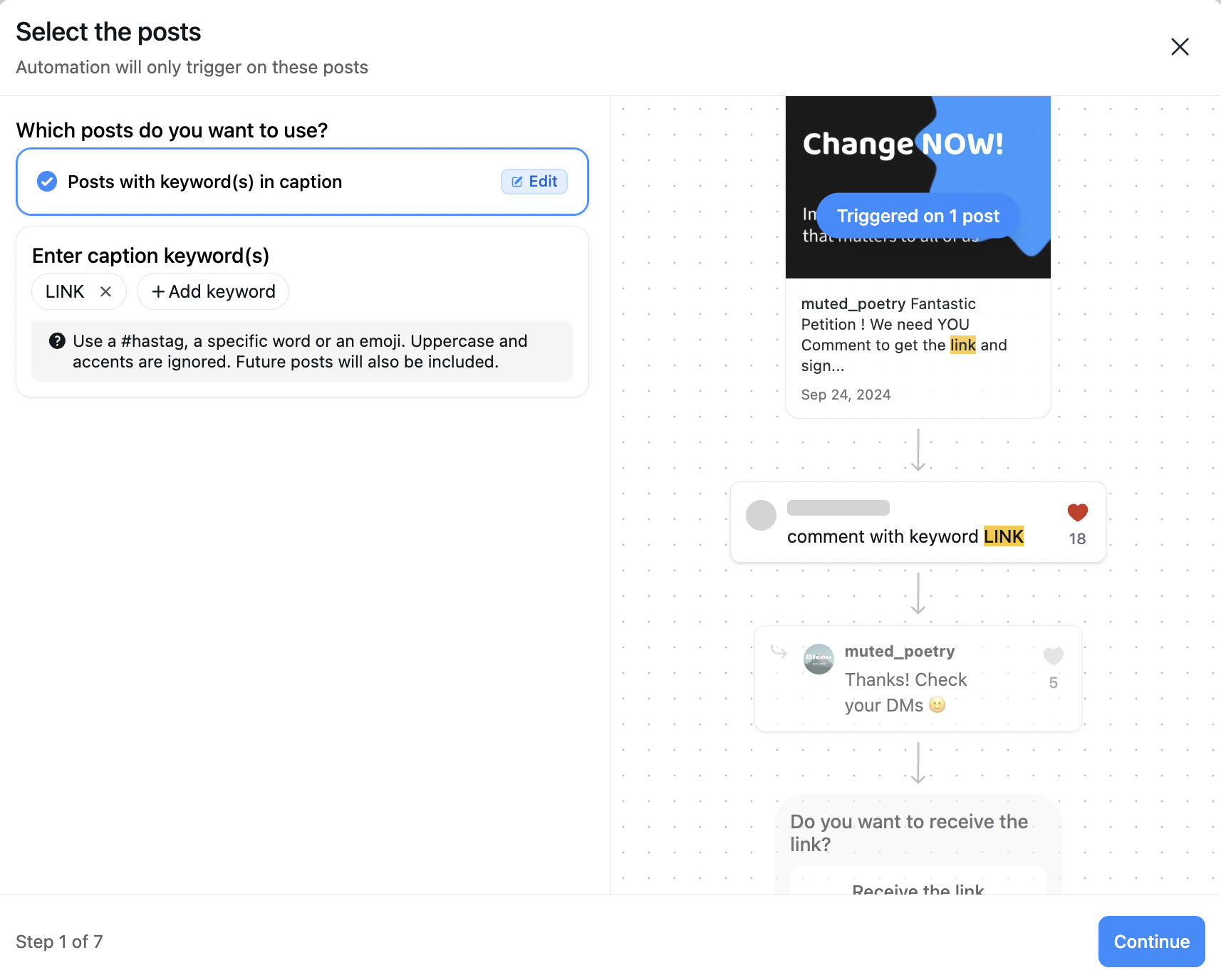
The classic comment-to-DM sequence looks like this: someone comments GUIDE, they get a public reply, then a DM asking for their email, then the delivery, then a follow-up offering the next step. Almost every tool can do the first three steps. Far fewer can do the last one, because it needs the contact tagged and retrievable after the automation ends.
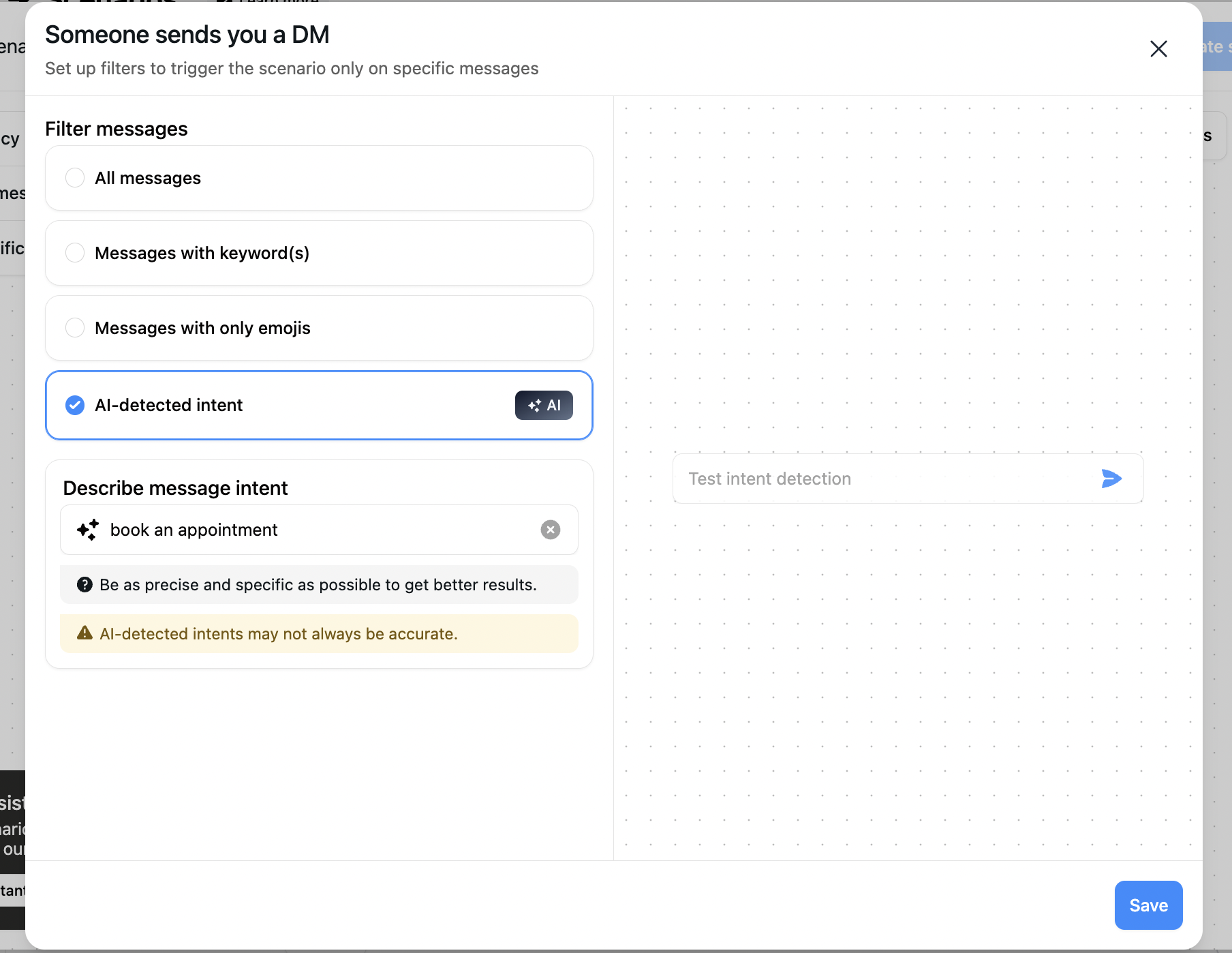
For repetitive inbound (order, tracking, returns, sizing, price), the failure mode is different. Keyword matching catches the obvious phrasings and misses everything else, so the inbox stays busy. Intent detection is what closes that gap, because it reads what someone meant rather than which word they used.
DM automation is one layer. Three others usually sit around it, and it is worth knowing which your DM tool already covers before you buy a second subscription.
The trap is buying four tools that each half-cover the same job. Start from the one place your revenue actually happens, which on Instagram is the DM, and add outward from there.
Capture leads from comments, qualify them in the DM, and keep every contact in one Instagram CRM. Free plan, no card.


Any tool that connects through Meta's official Instagram API, ideally a certified Meta Tech Provider. Inrō, ManyChat, Chatfuel, LinkDM and InstantDM all run on the official API. The connection method is only half of it: how you configure the automation matters as much, so avoid cold outreach and check which plan the pacing controls sit on before you buy.
A flow builder is enough when the conversation is predictable and short, such as delivering a lead magnet. An AI agent is worth it when people ask things you did not anticipate, when objections come before a sale, or when you want qualification to happen without you. Many teams run both: fixed flows for known paths, the agent for everything else.
Technically yes, practically no. Two tools listening to the same trigger will collide, and the person on the other end gets duplicate messages or none. If you need several entry points, pick one tool that covers all of them.
Look at where the free tier caps rather than the word free. ManyChat's free plan allows 25 active contacts a month, which one Reel with a comment trigger can use up in a day. LinkDM's free plan allows 1,000 DMs a month on one account. Chatfuel Light is free across three channels but includes no AI. InstantDM has no permanent free plan, only a 7-day trial. Inrō's free plan covers 100 active contacts, 3 automations, 3 DM campaigns and 50 AI Agent credits with no card.
Usually because the recipient has little prior interaction with your account, or the sending pattern looks automated. DMs triggered by someone commenting, replying to a Story or messaging you first land in the primary inbox far more reliably, which is another reason warm entry points outperform cold ones.
Instagram's API does not allow contact lists to be imported into any DM automation tool, so you cannot bulk-transfer an audience from one platform to another. Your list rebuilds as people engage with your new automations. Plan for that rather than being surprised by it, and export whatever emails and phone numbers you have captured before you cancel.
Entry paid plans run from about $12 to $29 a month, but the cheapest plan that includes a conversational AI agent is a different number: €12.99 on Inrō, $29 on ManyChat, $49 on Chatfuel, $97 on DM Champ. The billing model matters as much as the figure. Per active contact scales with a viral month, DM caps limit heavy senders, and credit-based plans drain faster on long conversations.
Join automations strategies and Instagram Insights weekly
By entering your email address above and clicking Subscribe, you consent to receive marketing communications (such as newsletters, blog posts, event invitations and new product updates), and targeted advertising from Inrō from time to time. You can unsubscribe from our marketing emails at anytime by clinking on the "Unsubscribe" link at the bottom of our emails. For more information about how we process personal information and what right you have on this respect, please see our Privacy Policy.
Connect your Instagram account and build your first automation in minutes. No code required.
.avif)
.avif)